And why the mushrooms growing there might be the cleanest you’ve ever cooked with.
There is a forest in central China where the air still smells like rain and wet bark. No factories for miles. No chemical runoff. No highways cutting through. Just old trees, mountain mist, and a silence that feels almost unnatural if you’ve spent your life in cities.
This is not a nature reserve built for tourists. It is a protected ecological zone — one that has remained largely free from industrial activity for over half a century.
And it is home to one of the rarest birds on Earth.
A bird that almost disappeared
The crested ibis — Nipponia nippon — is a bird most people have never heard of. In the 20th century, it was believed to be extinct in the wild. Then, in 1981, a small population was rediscovered in Shaanxi Province, China. Seven birds. That was all that was left.
What followed was one of the quieter conservation success stories of our time. Through habitat protection, captive breeding, and a lot of patience, the crested ibis slowly came back. Today, the wild population numbers in the thousands — still fragile, still protected, but no longer on the edge of vanishing.
The bird’s recovery depended on one thing above all else: a clean environment. The crested ibis is sensitive to pollution, pesticides, and habitat disturbance. It cannot survive in a place where the water is contaminated or the soil is sprayed with chemicals. Its presence is, in a very real sense, a signal that the ecosystem is intact.
If the ibis lives there, the forest is clean.
What grows in a forest like that
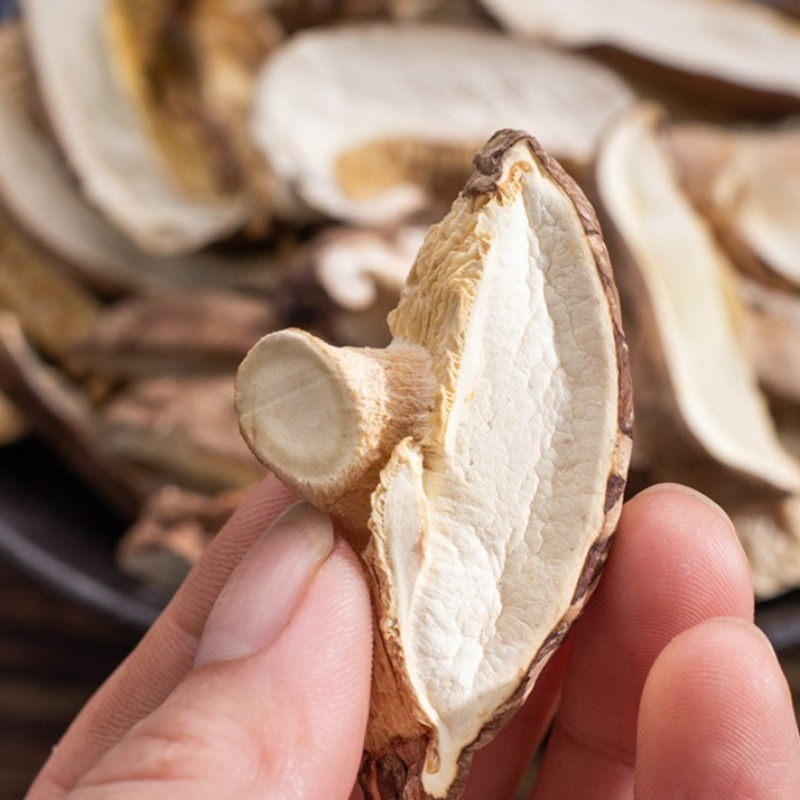
In the same protected zone, under the same clean air and unpolluted soil, shiitake mushrooms are cultivated the slow way.
No industrial accelerants. No chemical fertilizers. No shortcuts. The mushrooms grow on hardwood logs and natural substrates, absorbing what the forest gives them, and are then slowly dried to concentrate their flavor.
The result is a mushroom with a deep, earthy, savory character — the kind of umami that makes a pot of soup taste like it simmered all day, even when it didn’t.
But the flavor is only part of the story. The other part is what’s not in them. No sulfites. No preservatives. No additives to make them look brighter or last longer. Just one ingredient: shiitake mushrooms, from a forest that has been left alone long enough to prove itself.
Why origin matters more than you think
Most dried shiitake on the market is sold as a commodity. It comes from wherever is cheapest, gets pooled together, and arrives on a shelf with no story and no traceability. You don’t know where it grew, what it was exposed to, or how old it is.
That’s fine if you just need something to throw in a stir-fry. But if you’re feeding your family, or if you care about what’s actually in your food, origin matters.
A protected ecological zone is not a marketing label. It’s a set of legal restrictions: no heavy industry, no pesticide-heavy agriculture, no uncontrolled development. The crested ibis doesn’t care about branding. It only survives where the environment is genuinely clean.
That’s the standard we’re holding ourselves to. Not “natural” as a buzzword. Not “pure” as a slogan. But a real place, with a real bird, and a real reason to believe the mushrooms growing there are as clean as food gets.
How to use them
These are everyday mushrooms, not a luxury ingredient.
Soak a small handful in warm water for 20–30 minutes. They soften, plump up, and release a rich, savory liquid that you should absolutely not pour down the drain — that liquid is the base of a good soup, a braise, a ramen broth, or a simple pot of rice.
Toss the sliced mushrooms into anything that needs depth: congee, hot pot, braised pork, miso soup, even a weeknight pasta. A 150g pack lasts for dozens of meals, because a little goes a long way.
A quiet kind of proof
You can’t verify a forest from a product photo. You can’t taste a protected ecosystem in a single bite. But you can look for signals.
A bird that only lives in clean places. A growing region with no industrial history. A single ingredient on the label. A drying process that doesn’t rely on chemicals to fake freshness.
None of these things are flashy. But together, they tell you something that “premium” and “all-natural” never can: this food came from somewhere worth protecting.
And that’s the kind of place worth buying from.
https://trovecorner.com/product/dried-shiitake-mushroom-slices-150g/